
Quantum Design Jam — the event’s identity banner, showing concentric orange quantum circuit diagrams on black with The New School Innovation Center logo

IBM Quantum × Parsons School of Design · The New School

Quantum Design Jam

Three editions. 28 documented projects. The first sustained attempt to hand real quantum hardware to art and design students and see what they would make with it.

This is a single-page archive of every jam: the finalists, the award winners, the teams behind them, the workshops that taught them Qiskit, and the gallery show that took the work public. Team videos are embedded in place, and two of the winning games — Q-Sweeper and Quantum Tetris — are playable right here, running on data measured from real quantum hardware.

Editions
3
Projects
28
Participants
119+
Awarded
16
Works exhibited
11

A collaboration between

IBM QuantumThe New School Innovation Centerwith Parsons School of Design and the College of Performing Arts

What the jam is

In 2019, IBM approached The New School with a question: how could its emerging quantum computing technology be integrated into the creative arts and applied toward social good? The answer became the Quantum Lab — founded that year by Maya Georgieva and then-CIO Lin Zhou — and, in 2021, the Quantum Design Jam.

The format is deliberately unintimidating. Students are introduced to Qiskit and to building circuits visually in IBM Quantum Composer, then attend workshops run by IBM Quantum experts and work with IBM mentors through the week. No previous technical experience is required. Teams form across programs — fashion students next to architects next to economists — and pitch working prototypes to a panel of judges drawn from both institutions.

What makes the output interesting is that these teams were not trying to beat classical computing at anything. They were looking for affordances: qualities a quantum machine has that a classical one does not. Over and over, the answer they landed on was noise — the error that quantum engineers spend their careers suppressing, treated here as material.

Stated goals

  • Explore the affordances of quantum computing as an artistic medium.
  • Build quantum prototypes and experiments with Qiskit in a cloud programming environment.
  • Make quantum computing more accessible by demonstrating the vision with creative prototypes.
  • Educate the next generation of quantum computing practitioners, designers, and creative entrepreneurs.

Goals as published by the Innovation Center ↗. Content on this page is summarized and paraphrased from the sources listed in the archive.

Award categories

Most Creative Use of Quantum Technology in Visual Arts

Awarded 2021, 2022, 2023

Most Creative Use of Quantum Technology in Music

Awarded 2021, 2022

Most Creative Use of Quantum Technology

Awarded 2023

Honorable Mention

Awarded 2021, 2022

Community Portrait: Quantum Design JamYouTube ↗
Using Real Quantum Hardware to Make ArtYouTube ↗

The stack

  • Qiskit (Python)
  • IBM Quantum Composer
  • IBM Quantum hardware — incl. ibmq_lima
  • Quantum Music Playground
  • TouchDesigner
  • p5.js · Unity · Arduino

Two different jams

QCA documents two separate quantum jam lineages, and they are easy to confuse.

This page covers the Quantum Design Jam — art and design, at Parsons / The New School with IBM Quantum, three editions from 2021 to 2023, ending in a gallery exhibition in New York.

The Quantum Game Jam is a separate series — Finnish in origin, games-focused, running since 2014 and still going.

Quantum Game Jam archive, 2014–2026 →

First edition · October 1–9, 2021

2021 The first Quantum Design Jam

The inaugural jam ran October 1–9, 2021, hosted by The New School Innovation Center with the IBM Skills Academy and the IBM Quantum team. It was the first event of its kind: students and faculty from Parsons School of Design, the College of Performing Arts, and across The New School building with real quantum hardware alongside IBM Quantum experts.

Two tracks — Art & Design and Music — ran in parallel. The art track was led by Russell Huffman and Paul Kassebaum; the music track by James Weaver and Brian Ingmanson. Students from the Fall 2021 "Collab: Quantum Computing" course formed the core, joined by teams from across the university. Seven projects reached the closing pitch session at the IBM Collaborate space in NYC.

Format
Hybrid — 9 days
Tracks
Art & Design · Music
Finalist projects
7
Prerequisites
None
★ Most Creative Use of Quantum Technology in Visual ArtsExhibited 2023▶ Playable below

Quantum Tetris

Tetris where the blocks — and the glitches — come off a quantum computer.

Classical Tetris is only pseudo-random: a player who knew the seed could in principle predict every block. The team replaced that seed with a quantum circuit, so the piece order is genuinely unpredictable rather than merely hard to guess.

The more interesting result was the noise. The circuit was written to emit only the seven standard tetrominoes, but decoherence on real hardware produces miscalculations, and those errors materialize as illegal shapes that break the "four attached squares" rule. The team kept them, highlighted them in red, and turned hardware imperfection into a game mechanic — the longer you play, the noisier the board gets, which is also what happens the longer you run a quantum circuit.

Where the quantum is

A quantum circuit generates the block sequence; readout/decoherence noise produces the red "impossible" pieces.

Quantum TetrisVimeo ↗

Team · 5

  • Weijing Xiao — Parsons School of Design ’22
  • Emilio Lari — Parsons School of Design ’22
  • Tsung Han (Billy) Ho — Parsons School of Design ’22
  • Salil Parekh — Parsons School of Design ’22
  • Olivier Brückner — Parsons School of Design ’22
▶ Playable

Quantum Tetris

Runs live from olivierbrcknr.github.io
★ Most Creative Use of Quantum Technology in Music

Hycean

The music track’s winning composition.

The Innovation Center's award page records the team and the award; no further public documentation of this project has surfaced. If you worked on it, we would like to fill this in.

Hycean — team pitchThe New School MediaSpace ↗

Team · 3

  • Fangyuan Cheng
  • Xinxin Tian
  • Yechun Peng
★ Most Creative Use of Quantum Technology in Music

Hello Hycean

Recognized alongside Hycean in the music track.

The Innovation Center's award page records the team and the award; no further public documentation of this project has surfaced. If you worked on it, we would like to fill this in.

Hello Hycean — Siwei & M.Y.Y.The New School MediaSpace ↗

Team · 2

  • M.Y.Y. Mai
  • Siwei
Honorable Mention▶ Playable below

Q-Sweeper

Minesweeper rebuilt on quantum noise and entanglement.

Quantum Minesweeper. The board is not procedurally generated — all 1,024 tiles correspond to the 1,024 shots of a Bernstein–Vazirani circuit run on IBM's five-qubit lima backend, so the map is literally a visualization of the measurement distribution and its error floor.

Two mechanics come out of the physics. Entangled mines are linked in small groups: opening one reveals its partners without ending the game. "Interfering tomatoes" are scattered across the board in a proportion dictated by the qubit data, obscuring blank and numbered tiles. Sound effects were built in Ableton using IBM's Quantum Music Playground, and the whole thing is open source and playable in a browser.

Where the quantum is

Bernstein–Vazirani circuit on ibmq_lima; 1,024 shots map one-to-one onto 1,024 board tiles.

Q-Sweeper — explanation & walkthroughYouTube ↗

Team · 5

  • Yiping Dong — Sound design, video
  • Apurv Rayate — Game development, quantum computing
  • Hyacinth Weng — Game & front-end development, assets
  • Tanvi Mishra — Game & front-end development
  • Shangshang Li — Game development, sound design
▶ Playable

Q-Sweeper

Runs live from studio-degen.github.io

Also from this edition · 3

Honorable Mention

Entangled Moments

Entangled Moments — team pitchThe New School MediaSpace ↗

Team · 5

  • Lila Feldman
  • Munus Shih
  • Lavannya Suressh
  • Smitha Rao Aluri
  • Yash Goyal
Honorable Mention

Quantum Uniform

Quantum Uniform — team pitchThe New School MediaSpace ↗

Team · 4

  • Firas Zedan
  • Rama Deshpande
  • Khuplunmang Kipgen
  • Ishraq Ashtarian
Honorable Mention

Interlacing Qubits

Interlacing Qubits — team pitchThe New School MediaSpace ↗

Team · 5

  • Yiwen Zhang
  • Jiujin Feng
  • Jessie Han
  • Chayanit Thawaranont
  • Simone Liu

Second edition · October 14–22, 2022

2022 Art & Design and Music, in person

The second jam kicked off on October 14, 2022 at the University Center on Fifth Avenue and closed on October 22 with final pitches and an awards ceremony at the IBM Collaboration Space on Madison Avenue. It kept the two-track structure — Art & Design and Music — and opened to students from every New School program rather than only the quantum course.

Workshops that year included Getting Started with Quantum Composer with Nick Bronn of IBM and an introduction to TouchDesigner with Markus Heckmann of Derivative, which is why so many 2022 outputs are real-time generative visuals. This was also the first year with a promise attached: the strongest projects would go into the first-ever quantum art exhibition in New York the following spring.

Format
In person — 9 days
Tracks
Art & Design · Music
Documented projects
12
Outcome
Gallery exhibition, 2023
★ Most Creative Use of Quantum Technology in Visual ArtsExhibited 2023

Quantum Brownies

A brownie recipe system with 16.7 million outcomes, generated by a three-qubit circuit.

An excerpt from what the team called The Quantum Cooking Recipe Collection — the first of its kind. A three-qubit circuit produced the dataset, which was mapped onto ingredients, quantities, and method to yield a recipe space of more than 16.7 million possible brownies.

Rather than filter the hardware's error out, the team leaned into it, treating noise as a co-author and using superposition and entanglement as recipe logic. It is one of the more literal answers to the jam's question of what quantum computing looks like in everyday life.

Where the quantum is

Three-qubit circuit output mapped to recipe parameters; measurement noise left in as a generative ingredient.

Quantum Cooking: A Case Study with BrowniesVimeo ↗

Team · 3

  • Krithi Nalla — BFA Design & Technology, Parsons
  • Shashwath Santosh — BFA Product Design, Parsons
  • Six Lauture — MFA Design & Technology, Parsons
★ Most Creative Use of Quantum Technology in MusicExhibited 2023

[a]synchronous

The music track winner, later shown at Microscope Gallery.

The Innovation Center's award page records the team and the award; no further public documentation of this project has surfaced. If you worked on it, we would like to fill this in.

Team · 3

  • Julia Daser — BFA Design & Technology, Parsons
  • Theingi Thann — BFA Communication Design, Parsons
  • Yi Qing (Pepi) Ng — BFA Design & Technology, Parsons
Honorable MentionExhibited 2023

Amorphous

Quantum data as digital fashion — generative patterns driven in TouchDesigner.

Amorphous treats quantum output as a source of identity rather than of imagery: the team used it to drive generative patterns for digital garments in TouchDesigner, extending digital fashion and digital self-identity past what a designer would choose by hand.

The team's stated next step was to run Qiskit inside TouchDesigner so the data arrives live, and to hand pattern generation to wearers so they could customize garments from their own identity data.

Where the quantum is

Quantum measurement data mapped to pattern parameters in a real-time TouchDesigner system.

AmorphousYouTube ↗
Quantum — Amorphous visualsYouTube ↗

Team · 4

  • Yalin Hu — MFA Design & Technology, Parsons
  • Yamei Liao — MFA Design & Technology, Parsons
  • Yinan Chen — MFA Design & Technology, Parsons
  • Lynette Huang — MFA Design & Technology, Parsons
Honorable Mention

Quantum Choreography

Superposition performed with a body and a strobe light.

Working with physicist Paul Kassebaum as mentor, the team bridged IBM Quantum Composer and TouchDesigner to ask what superposition looks like when a dancer performs it. Strobe light does the work a diagram usually does: a body caught mid-movement reads as occupying several positions at once until the eye collapses it into one.

Where the quantum is

Quantum Composer circuits piped into TouchDesigner to drive strobe and visual response to movement.

Team · 5

  • Gabriel Lee — MFA Design & Technology, Parsons — copywriting
  • Guan-Hao Zhu — MFA Design & Technology, Parsons — design & film
  • Marshall Wang — MFA Design & Technology, Parsons — visual design
  • Xiaoyu Zhang — Movement
  • Derrek Chau — Technical support
Exhibited 2023

Dice or Die

A side-scroller where the dice are quantum and the odds are honest.

A 2D side-scrolling dice game built to make quantum uncertainty playable: whether you win or lose is settled by a probability distribution that came off a quantum machine, not a random() call.

The team prototyped circuits in IBM Quantum Composer and found the hardware unpredictable, imperfect, and noisy — then made that the premise rather than a problem. Built with Arduino, C++, and p5.js, it was shown at Microscope Gallery in March 2023.

Where the quantum is

Circuits built in IBM Quantum Composer; the resulting distribution drives the dice rolls.

Dice or Die — Quantum Art ExhibitionYouTube ↗

Team · 4

  • Christine Chang — BFA Design & Technology, Parsons
  • Anna Bui — BFA Communication Design, Parsons
  • Arshya Gupta — BFA Design & Technology, Parsons
  • Seobin Park — BFA Design & Technology, Parsons
Exhibited 2023

Move-a-Bit

Motion capture meets entanglement and superposition.

A motion-capture project investigating where quantum computing meets art and design. The team studied entanglement and superposition closely enough to implement a working circuit, then used it to shape captured movement. Shown at both Microscope Gallery and the Sheila C. Johnson Design Center.

Team · 4

  • Isabella Wang — BFA Illustration, Parsons
  • Youn Hwang — BFA Strategic Design & Management, Parsons
  • Paridhi Garg — BFA Design & Technology, Parsons
  • Kalinda Panholzer — BS Media Studies, Parsons

Also from this edition · 6

Honorable MentionExhibited 2023

Qbik

Team · 5

  • Max Emrich — MFA Transdisciplinary Design, Parsons
  • Frida Moreno — MFA Transdisciplinary Design, Parsons
  • Ayman Mir — MFA Transdisciplinary Design, Parsons
  • Itai Lavie — BFA Design & Technology, Parsons
  • Daron Woods — MS Economics, NSSR
Honorable MentionExhibited 2023

Quantum Poetry

Exhibited the following spring as Poetic Quantum.

Team · 5

  • Hong Hua — MFA, Parsons
  • Simran Jagnik — MFA Design & Technology, Parsons
  • Yixuan Liu — MFA, Parsons
  • Sahiti Agarwal — MFA Design & Technology, Parsons
  • Yuyuan Jin — MFA, Parsons
Honorable Mention

Incestuous Penguin Colony

Team · 6

  • Terry Kahn — MFA Design & Technology, Parsons
  • Arianna Locatelli — MFA Design & Technology, Parsons
  • Jakob Sitter — MFA Design & Technology, Parsons
  • Jonny Hopkins — MFA Design & Technology, Parsons
  • Iann Gonzalez — BFA Design & Technology, Parsons
  • Gabriel Torres — MFA Media Studies, Schools of Public Engagement
Exhibited 2023

Generative Flakes

Team · 4

  • Peilin Chen — Parsons School of Design
  • Lavannya Suressh — Parsons School of Design
  • Xiyue Yang — Parsons School of Design
  • Juliana Serna — Parsons School of Design
Exhibited 2023

OCELLI

Team · 2

  • Gretchen Hollis — MFA Design & Technology, Parsons
  • Bowen Li — MFA Design & Technology, Parsons
Exhibited 2023

Spooky Actions

Team · 5

  • Sylviane Bahati — BBA Strategic Design & Management, Parsons
  • Madeline Mulvey — BFA Integrated Design, Parsons
  • Aaron Norman — BFA Architectural Design, Parsons
  • Zeshan Khalid — MFA Design & Technology, Parsons
  • Yuxi Zhou — BFA Fashion, Parsons

Third edition · October 13–22, 2023

2023 Ten teams, ten prototypes, one week

The third annual jam ran October 13–22, 2023 in partnership with Qiskit. Ten teams explored, ideated, and built ten distinct projects inside an accelerated one-week sprint — the largest and most disciplinarily mixed cohort yet, pulling in architecture, journalism, economics, fashion, industrial design, and media studies alongside design and technology.

Paul Kassebaum returned to give the keynote, "Making quantum information tangible," this time from SandboxAQ. Sven Travis ran the Qiskit workshop, and two students who had come up through earlier jams — Leffin John Christopher and Julia Daser — led a workshop of their own, "Spooky Action at a Distance." The program had started producing its own teachers.

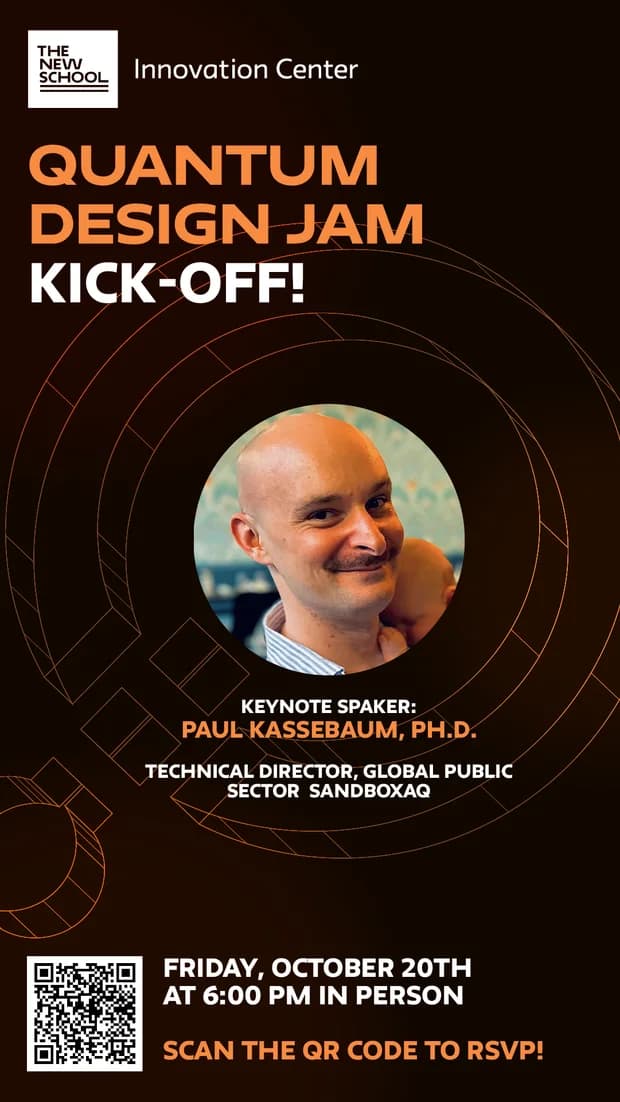
Quantum Design Jam 2023 kick-off poster, billing Paul Kassebaum of SandboxAQ as keynote speaker on Friday October 20th
The 2023 kick-off poster · The New School Innovation Center
Format
One-week sprint
Partner
Qiskit
Teams
10
Keynote
Paul Kassebaum, SandboxAQ
★ Most Creative Use of Quantum Technology in Visual Arts

The Quantum Vase

A co-creation tool that turns quantum data into 3D-printable parametric objects.

A digital platform that uses quantum data to make design decisions, generating and customizing parametric objects for 3D printing — vases, specifically, chosen because form is easy to read and hard to fake.

It is one of the few jam projects aimed squarely at production rather than demonstration: quantum output becomes a manufacturable object with a real toolchain behind it.

Where the quantum is

Quantum data feeds the parametric model that determines each vase’s geometry.

Team · 5

  • Annie Xing — BA Economics / BFA Fashion Design, Parsons
  • Cody Burchfield — Master of Architecture, Parsons
  • Juliana Serna — BS Industrial Design, MFA Design & Technology, Parsons
  • Nancy Wei — BA/MA Journalism + Design, Eugene Lang / NSSR
  • Shaoran Liang — MPS Communication Design, Parsons
★ Most Creative Use of Quantum Technology

Qumba’s first day of work

The Innovation Center's award page records the team and the award; no further public documentation of this project has surfaced. If you worked on it, we would like to fill this in.

Team · 3

  • Robin Altman — BFA Design & Technology, Parsons
  • Seobin Park — BFA Design & Technology, Parsons
  • Christine Chang — BFA Design & Technology, Parsons

Quantum Slots

A gambler’s delight running on real hardware noise.

A slot machine that depends on the random noise quantum systems generate to produce genuine uncertainty — the house edge replaced by decoherence.

Team · 6

  • Sanyukta Bhonsle — MA Media Studies ’24
  • Jin TianJi — MFA Design & Technology ’24, Parsons
  • Qian Xiang — BFA Communication Design ’24, Parsons
  • Amelia Dodson — BFA Integrated Design ’24, Parsons
  • Sebastian Guerrero — BFA Fine Arts ’25, Parsons
  • Rohan Jadal — BFA Product Design ’25, Parsons

When It Rains, It Qubits

Intersectional flood modeling.

The clearest social-impact entry of the 2023 cohort: quantum-assisted flood modeling read through an intersectional lens, asking who is actually exposed when the water arrives rather than only how much of it there is.

Team · 5

  • Wasim Abbas — MS Strategic Design & Management ’24, Parsons
  • Sienna Eve — MFA ’24, Parsons
  • Josh Gritz — MA ’24, Parsons
  • Sid Tikku — BFA Communication Design ’24, Parsons
  • Drif Dong — MFA Industrial Design ’24, Parsons

Also from this edition · 5

Bio Bits

Team · 3

  • Frida Moreno Cabrera — MFA Transdisciplinary Design ’24, Parsons
  • Skylar Ziyi Wang — MFA Design & Technology ’24, Parsons
  • Shristi Singh — MFA Design & Technology ’24, Parsons

Barzakh Yuan

Team · 4

  • Wenjia Yan — MFA Transdisciplinary Design ’24, Parsons
  • Malak Musa — MFA Transdisciplinary Design ’24, Parsons
  • Siyuan Fu — MFA Design & Technology ’24, Parsons
  • Jianting Deng — MFA Transdisciplinary Design ’24, Parsons

Distentanglement

Team · 5

  • Arianna Marj Ginette Locatelli — MFA Design & Technology ’24, Parsons
  • Nicolette (Nikki) Damianou — MFA Design & Technology ’24, Parsons
  • Anne-Isabelle (Leo) de Bokay — MFA Design & Technology ’24, Parsons
  • Vasiliki Hadzikosta — MFA Design & Technology ’24, Parsons
  • Juwon Lee — MFA Design & Technology ’24, Parsons

A Bird’s Eye View: Quantum Entanglement & Superposition

Team · 4

  • Ally Luo — MFA Design & Technology ’24, Parsons
  • Preston Bourne — BFA Design & Technology ’24, Parsons
  • Shayla Lee — BFA Design & Technology ’24, Parsons
  • Zelong Li — BFA Design & Technology ’24, Parsons

Entangled Destiny

Team · 5

  • Soy Kim — BFA Design & Technology ’24, Parsons
  • Minkyung Cho — BFA Communication Design ’25, Parsons
  • Francine Zhou — BFA Communication Design ’25, Parsons
  • Jessica Chen — BFA Design & Technology ’25, Parsons
  • Flora Cao — BFA Design & Technology ’26, Parsons

March 2023 · Microscope Gallery, New York

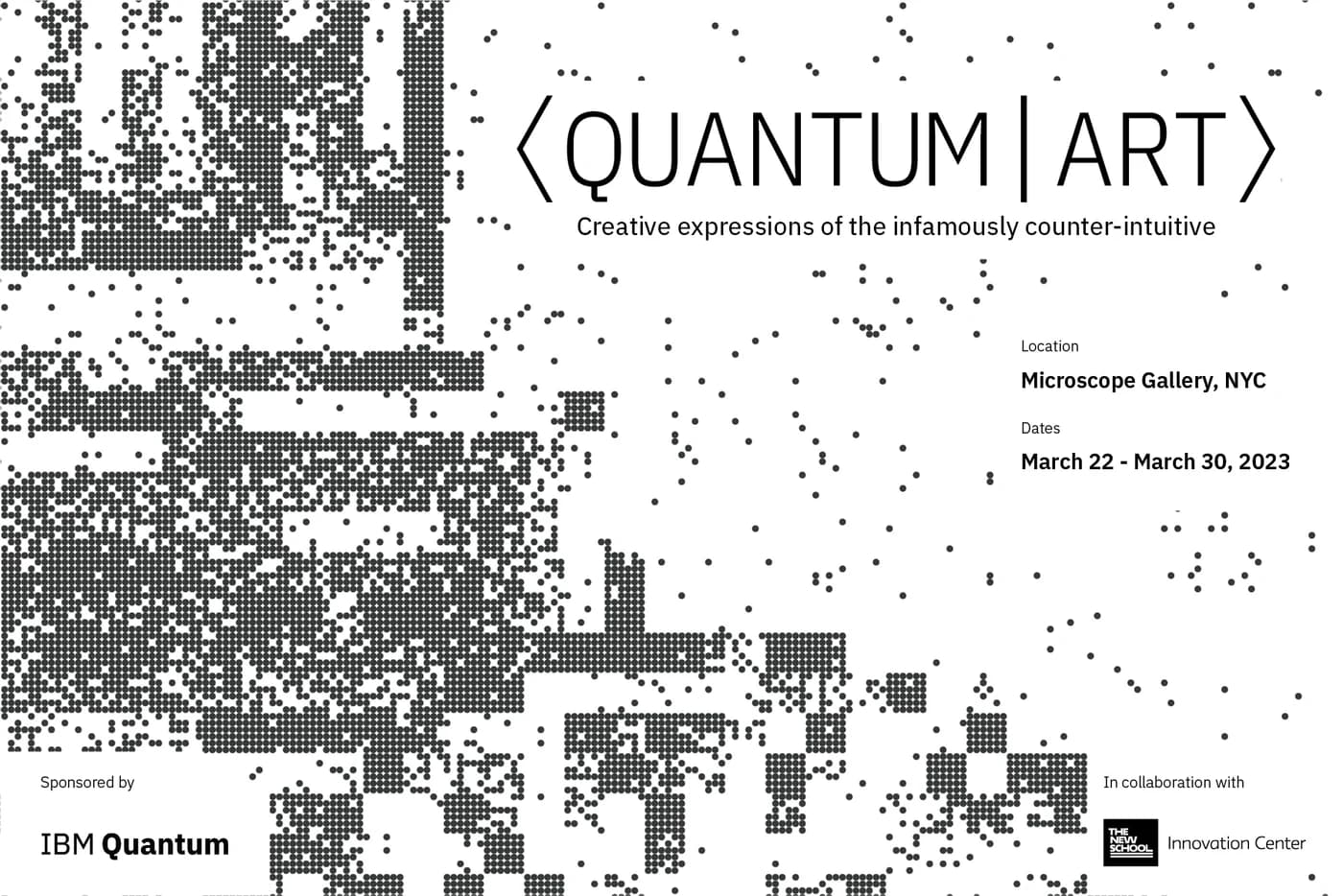
⟨QUANTUM | ART⟩ — Creative expressions of the infamously counter-intuitive

QUANTUM ART: Creative Expressions of the Infamously Counter Intuitive

The first quantum art exhibition of its kind in New York. Fifteen works in total: eleven student projects incubated through the Quantum Design Jams, shown alongside pieces by Russell Huffman, the Qiskit design lead at IBM Quantum and one of the field’s earliest practitioners.

Curated by Maya Georgieva, the show was framed as a provocation rather than a survey — an argument that quantum computing has affordances an artist can work with, and that the people best placed to find them are not necessarily physicists.

The eleven student works came out of the 2021 and 2022 jams, which is the clearest measure of what the program did: a one-week class exercise ended up on a Chelsea gallery wall eighteen months later. Quantum Poetry was shown as Poetic Quantum.

The QUANTUM ART exhibition card: the wordmark and show details beside a dense dot-matrix pattern derived from quantum measurement data, with IBM Quantum credited as sponsor and The New School Innovation Center as collaborator
The exhibition card, reproduced as published · The New School Innovation Center × IBM Quantum

Student works shown · 11

[a]synchronousAmorphousDice or DieGenerative FlakesMove-a-BitOCELLIPoetic QuantumQbikQuantum BrowniesQuantum TetrisSpooky Actions
Venue
Microscope Gallery, 525 West 29th Street, 2nd floor, New York
Dates
March 22–30, 2023 — Public hours began Thursday March 23, Tuesday–Saturday, 12:00–6:00 p.m.
Curator
Maya Georgieva
Works
15 total — 11 student projects + works by Russell Huffman

Mentors, judges & faculty

The people who ran it

A small group carried the jam across all three years — the IBM Quantum staff who taught the workshops and mentored teams, and a New School core that built the Quantum Lab around them. By 2023, former participants were teaching the workshops.

IBM Quantum · 6

Russell Huffman

2021 · 2022

Qiskit Design Lead

Led the quantum art track and mentored teams; his own work hung in the 2023 exhibition.

Paul Kassebaum

2021 · 2022 · 2023

Quantum Partnership Developer

Co-led the art track, mentored Quantum Choreography, and returned in 2023 to keynote from SandboxAQ.

James Weaver

2021 · 2022

Quantum Developer Advocate

Co-led the music track and the Quantum Music Playground workshop.

Brian Ingmanson

2021 · 2022

Education Engagement Lead

Co-led the music track.

Nick Bronn

2022

IBM Quantum — Quantum Composer workshop

Austin R. Flon

2022

Innovation Hub Leader, NYC — IBM Ventures

The New School · 7

Maya Georgieva

2021 · 2022 · 2023

Senior Director, Innovation Center

Co-founded the Quantum Lab in 2019, organizes the jam, and curated the 2023 exhibition.

Dr. Lin Zhou

2021 · 2022 · 2023

SVP & CIO (2019–2024)

Co-founded the quantum initiative and co-taught the Collab: Quantum Computing course. Now CIO at Texas Tech and a Texas Quantum Initiative Advisory Committee appointee.

Sven Travis

2021 · 2022 · 2023

Associate Professor of Media and Design, Parsons

Launched Parsons’ original Design & Technology program; co-taught the quantum course and ran the Qiskit workshops.

Anthony Dunne

2021

University Professor of Design and Social Inquiry

Fiona Raby

2021

University Professor of Design and Social Inquiry

Harpreet Sareen

2021

Assistant Professor, Interaction and Media Design, Parsons

Daniel Sauter

2021 · 2023

Professor of Data Visualization, Parsons

Guest facilitators & judges · 4

Omar Costa Hamido

2021

Quantum computing musician and researcher, University of Plymouth

Markus Heckmann

2022

Derivative — TouchDesigner workshop

Leffin John Christopher

2023

Parsons MFA Design & Technology ’23 — "Spooky Action at a Distance" workshop

Julia Daser

2023

Parsons BFA Design & Technology ’25 — "Spooky Action at a Distance" workshop

Won the 2022 music track with [a]synchronous, then came back to teach.

Curriculum

Workshops & sessions

How designers with no physics background got to a working circuit in a weekend. The 2021 sessions were recorded and are preserved in The New School's video archive.

2021

Intro to Quantum Computing for Artists

Russell Huffman & Paul Kassebaum

Every technology can be an artistic medium, and every medium has affordances. A primer on the physics, how it can be exploited for expression, and a step-by-step walkthrough to a finished composition running on real quantum systems.

Intro to Quantum Computing for ArtistsThe New School MediaSpace ↗

Composing Quantum Dance Music

James Weaver & Brian Ingmanson

Music has always been used to demonstrate new computing — an ILLIAC machine was composing string quartets in the 1950s. This session covers how a quantum computer can collaborate on a track, using the Quantum Music Playground on a Qiskit simulator.

Composing Quantum Dance Music: A Musical Journey Into Quantum ComputingThe New School MediaSpace ↗

Getting Started with Qiskit

Paul Kassebaum & Sven Travis

The hands-on onramp: building circuits in Qiskit and IBM Quantum Composer with no prior tech background assumed.

Getting Started with Qiskit WorkshopThe New School MediaSpace ↗

Information Session

Innovation Center & IBM Quantum

The pre-jam briefing — what the week would involve and how teams would form.

Quantum Design Jam Information SessionThe New School MediaSpace ↗

2022

Getting Started with Quantum Composer

Nick Bronn, IBM Quantum

Visual circuit building in IBM Quantum Composer, the entry point for teams with no Python background.

Intro to TouchDesigner

Markus Heckmann, Derivative

The reason so much 2022 work is real-time generative visuals — a bridge from quantum data to live rendering.

2023

Keynote: Making quantum information tangible

Paul Kassebaum, SandboxAQ

On making quantum understandable, relevant, and physically graspable — from a physicist who has spent a decade translating it.

Spooky Action at a Distance

Leffin John Christopher & Julia Daser

A workshop taught by two students who had come up through earlier jams — the program teaching itself.

The full 2021 recording set — team pitches plus all three workshops and the information session — lives in one playlist on The New School MediaSpace ↗.

Recognition

What the program won

The jam was not only a student competition — the initiative behind it collected awards of its own, three years running.

2021

FutureEdge 50 Award

IDG / CIO

Recognizing advanced trials and applications of emerging technology.

2022

Gold Prize, Developing Emerging Skills and Competencies

Wharton-QS Reimagine Education

For "Harnessing Quantum Computing for the Future of Arts & Humanities."

2023

CIO 100 Award

CIO

For innovative institutional use of information technology.

Beyond the jam

The program traveled. In March 2022 the Innovation Center presented Quantum Computing for Design and Social Good ↗ at SXSW in Austin, framing the jam as a case study in bringing access, ethics, and inclusion into a technology while it is still being built. Lin Zhou, who co-founded the initiative, was later appointed to the Texas Quantum Initiative Advisory Committee ↗.

Archive

Every source, in one place

42 primary sources behind this page — the Innovation Center's own records, the video archive, press coverage, and the teams' own documentation. Several of these pages are the only public record of their project, so they are listed in full rather than summarized away.

Official · 18

Projects & portfolios · 14

Project descriptions are paraphrased and condensed from the teams' own documentation and the Innovation Center's published pages; all names, programs, and awards are recorded as published. Content was rephrased for compliance with licensing restrictions. Videos are embedded from their original platforms and load only when you press play. Event posters, identity artwork, and the institutional marks shown here remain the property of The New School and IBM, reproduced to identify and document the event. If you took part in a jam and something here is wrong or missing, we want to fix it.